Orthopedic • Trauma • Joint Replacement • Arthroscopy Surgeon
Flagship Specialty

Personalized Knee Arthroplasty

Caliper-Aligned Kinematic Knee Replacement Surgery

What Is Knee Replacement?

In simple terms, knee replacement is a surgical procedure in which the damaged surfaces of the knee joint are removed and replaced with carefully designed prosthetic components.

The knee is the largest joint in the body. Its surfaces are covered by smooth cartilage that allows pain-free movement. When arthritis or injury damages this cartilage, movement can become painful, stiff, and limited.

Knee replacement surgery aims to restore a smooth, functional, and less painful joint surface, allowing patients to return to many of the activities they value.
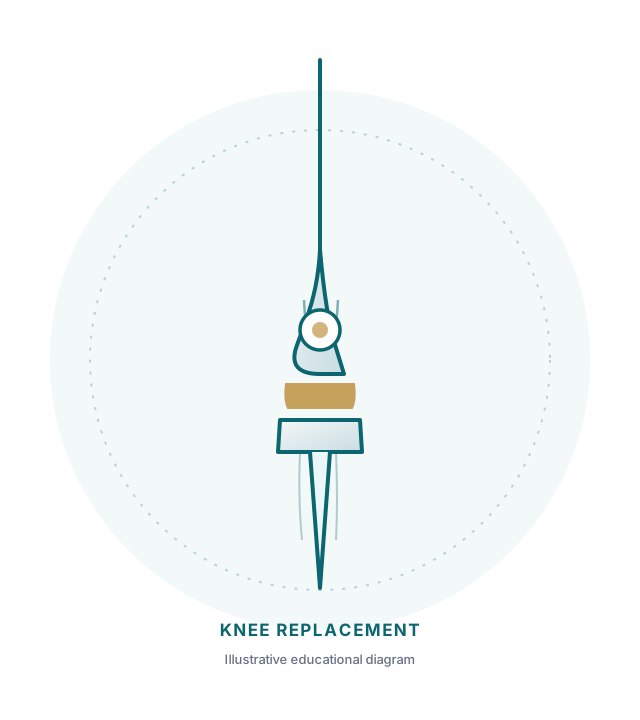

Illustrative diagram of a knee replacement implant
Indications

Why Might Knee Replacement Be Considered?

Knee replacement is not the first step for every knee problem. It is generally discussed when patients experience:

Advanced Arthritis

Significant joint-surface damage from arthritis, visible on appropriate imaging.

Persistent Pain

Pain that continues despite appropriate non-surgical treatment.

Functional Limitations

Difficulty performing daily activities such as walking, climbing stairs, or rising from a chair.

Reduced Mobility

Restricted knee movement affecting independence and quality of life.

Non-Surgical Treatment No Longer Effective

When appropriate non-surgical measures no longer control symptoms adequately.

These are general indications. Whether knee replacement is appropriate is decided only after an individual evaluation and discussion of your specific circumstances.
Personalized Approach

Personalized Knee Arthroplasty

No two knees are identical — and no two patients are identical. Personalized knee arthroplasty is an approach to knee replacement in which surgical planning considers the individual anatomy and characteristics of each patient.

This includes looking at how the patient's knee is shaped, how the joint surfaces wear, how the ligaments and soft tissues behave, and what the patient hopes to achieve. The aim is a plan that is tailored to the individual rather than applied uniformly to every patient.

For Dr. Manish, personalization is central to how knee replacement is discussed, planned, and performed.

Individual Anatomy

Each patient's unique bone and joint structure is considered during planning.

Soft-Tissue Balance

Ligament function and balance are respected to guide component placement.

Functional Alignment

Planning aims to restore the knee's natural functional alignment.

Patient Goals

The patient's lifestyle and expectations help shape the discussion.

Illustration of kinematic alignment of the knee

What Is Kinematic Alignment?

Kinematic alignment is a concept in knee replacement planning that focuses on respecting the patient's own joint alignment rather than forcing every knee into a single standard template.

Traditional knee replacement planning often aims to recreate a uniform "neutral" alignment for all patients. Kinematic alignment instead recognises that the alignment of a patient's knee before surgery is often the alignment their body has learned to move with.

By aligning the components to the patient's individual anatomy and balancing the soft tissues around the joint, kinematic alignment aims to restore a more natural knee function and movement pattern.

In Plain Language

Think of it as tailoring a suit to the person wearing it, rather than making one standard size for everyone. The goal is a knee that feels natural for that particular patient.

The Technique

What Does Caliper-Aligned Mean?

The caliper is a precision measuring instrument — the same kind of instrument a master craftsman might use to measure a component to a fraction of a millimeter.

Measured Precision

Intraoperative measurement helps guide precise, individualized component placement.

Kinematic Reference

Measurements are referenced against the patient's own kinematic alignment.

Individualized Planning

Every knee is planned on its own merits rather than a one-size-fits-all template.

Balanced Technique

The approach emphasizes soft-tissue balance alongside component positioning.

This explanation is educational. Surgical techniques are selected based on individual patient evaluation, and no claim of superiority over other techniques is made here.
Preparation

Before Surgery

A careful preparation process helps ensure that surgery is only considered when appropriate and when the patient is well prepared.

Consultation

A detailed discussion of symptoms, history, and treatment goals.

Clinical Examination

A careful physical examination of the knee and related structures.

Imaging

X-rays and, when appropriate, other imaging to assess the joint.

Medical Assessment

Review of overall health to help plan a safe surgical journey.

Surgical Planning

An individualized plan based on the patient's anatomy and findings.

Discussion & Consent

A clear explanation of the procedure, benefits, and possible risks.

After Surgery

Recovery from knee replacement is a gradual process and varies from person to person. It involves a structured program that typically includes:

  • Rehabilitation — guided exercises to restore movement and strength.
  • Physiotherapy — support from trained professionals in the recovery period.
  • Follow-up — scheduled reviews to monitor progress and healing.
  • Gradual recovery — returning to normal activity over time, at a pace that suits each individual.
Important

Individual recovery varies. Outcomes depend on many factors, and no guarantee of a specific result can be made. Your care team will discuss realistic expectations with you.

Recovery Principles

Early Movement

Guided movement begins early, under medical supervision.

Structured Physiotherapy

A progressive exercise plan tailored to the individual.

Regular Follow-Up

Scheduled reviews to track healing and progress.

Realistic Expectations

Recovery time and outcomes differ for every patient.

Considering Knee Replacement?

Start with a consultation to understand your knee, your options, and whether surgery is the right step for you.

Information on this website is provided for general educational purposes and does not replace an in-person medical consultation, diagnosis, or individualized treatment plan.